

Introduction
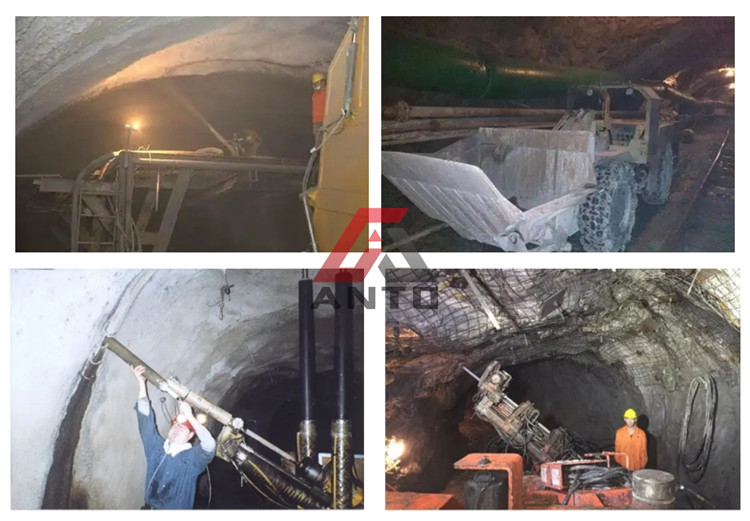
At present, the mining of mineral resources in China is still mainly based on underground roadway mining, and roadway support is the key technical equipment to ensure safe production in mines. Therefore, the rationality of the support structure and the reliability of the support equipment are important to the safety of the roadway working face roof. great influence. As the mining depth of mines in China continues to increase, the underground mining conditions are getting worse, and the mining operations in deep wells are becoming more and more difficult. In order to ensure the safety of production operations under deep well conditions, deep well roadway support must comprehensively consider various external factors that interfere with the normal production of the mine.
Mine support equipment is a support tool used by mine production enterprises in order to maintain the safety of the mining face and provide a safe working environment for construction workers in the mining processes such as underground rock drilling and blasting, transportation, ventilation, and filling. With the development of the mining industry, China's annual investment in mine support equipment continues to increase. Taking the coal industry as an example, in the mine support operation, the annual consumption of wood exceeds 400x104m, steel 50x1044t, plus Various auxiliary equipment and tools, etc., the total investment cost is about 20x108yuan. It can be seen that the application and development of mine support technology and equipment is very rapid.
1 Mine support theory
1.1 The New Austrian Law Support Theory
The new Austrian method of support theory regards the surrounding rock as an integral part of the supporting structure, and focuses on maximizing the bearing capacity of the surrounding rock itself. In the early stage of roadway excavation, the surrounding rock is reinforced with spray diameters and bolts in advance. , to avoid the relaxation and unloading of the surrounding rock, use bolt and shotcrete support to improve its bearing capacity, and minimize the disturbance to the surrounding rock, and use monitoring and measurement methods to evaluate the reinforced surrounding rock to control the deformation of the surrounding rock in Fengjie. , and make maximum use of the bearing capacity of the surrounding rock itself.
1.2 Composite support theory
The theory of compound support holds that before the excavation of the roadway, the magnitude and direction of the surrounding rock stress are kept in a balanced state. The excavation of the roadway breaks this equilibrium state, and the stress in the local area of the surrounding rock is concentrated, which causes the surrounding rock to deform, and finally makes the surrounding rock. The rock was damaged and collapsed. Therefore, in order to prevent the surrounding rock from collapsing, we must start from the root cause, that is, support the surrounding rock with supporting equipment to control the deformation of the surrounding rock. overall rock stability. The composite support theory is often used in roadways with complex geological environment. However, due to the dynamic change of the geological conditions in the roadway, the stability of the surrounding rock gradually decreases with the passage of time. Therefore, this support theory is not suitable for roadways that require long-term stability.
1.3 The theory of strength enhancement of surrounding rock
According to the theory of strength enhancement of surrounding rock, the surrounding rock of roadway generally exists in glass broken zone, plastic zone, elastic zone and other regions. When the staggered rod support is used, the interaction force is generated between the rock mass and the bolt in these anchoring areas. The mechanical properties of the rock, change the stress state of the surrounding rock, improve the bearing capacity of the surrounding rock, strengthen the bearing capacity of the bolt and the rock mass in the anchoring area, thereby controlling the displacement and development of the crushed zone and the plastic zone around the roadway , which enhances the stability of the surrounding rock of the roadway.
1.4 Theory of rock bolt support
At present, the supporting theories used to guide the bolt support mainly include: suspension theory, grouping beam theory, span reduction theory, combined arch theory and so on. Suspension theory holds that the anchor rod is to suspend the weaker rock formation on the roadway roof on the upper stable rock formation. Under the action of pre-tightening force, the gravity of the surrounding rock within a certain range around each anchor rod is transmitted to the hard rock formation through the anchor rod. , thereby strengthening the surrounding rock. The composite beam theory believes that the compressive force generated by the anchor rod to each group of plate beams redistributes the compression force and tensile force between the plate beams of each layer, and strengthens the overall bearing capacity of the composite plate beam, so that the The flexural strength of the beam as a whole is improved; the span reduction theory holds that the anchor rods whose ends are set in the stable rock layer can be regarded as a hinge point, and these anchor rods divide the roadway roof into several small spans, thereby reducing the roof deflection; The composite arch theory holds that when the bolts are set along the archway according to the distance between the platforms, under the action of pre-tightening force, each bolt has a certain range of stress action, and the overlapping area of these action ranges forms a A continuous extruded arch reinforcement belt can more effectively resist the stress and deformation of the surrounding rock.